Training in artificial intelligence, digital marketing and leadership

Better understand change. Sharpen critical thinking. Make better decisions.

I offer professional training and workshops for executives, managers and teams who want to step back from the technological, economic and social changes affecting their organizations.

Gabriel TasséAn entrepreneur for nearly 20 years and a lecturer at HEC Montréal, its École des dirigeants and the Institut de leadership, I like to make complex subjects accessible without losing the nuances that make them interesting.

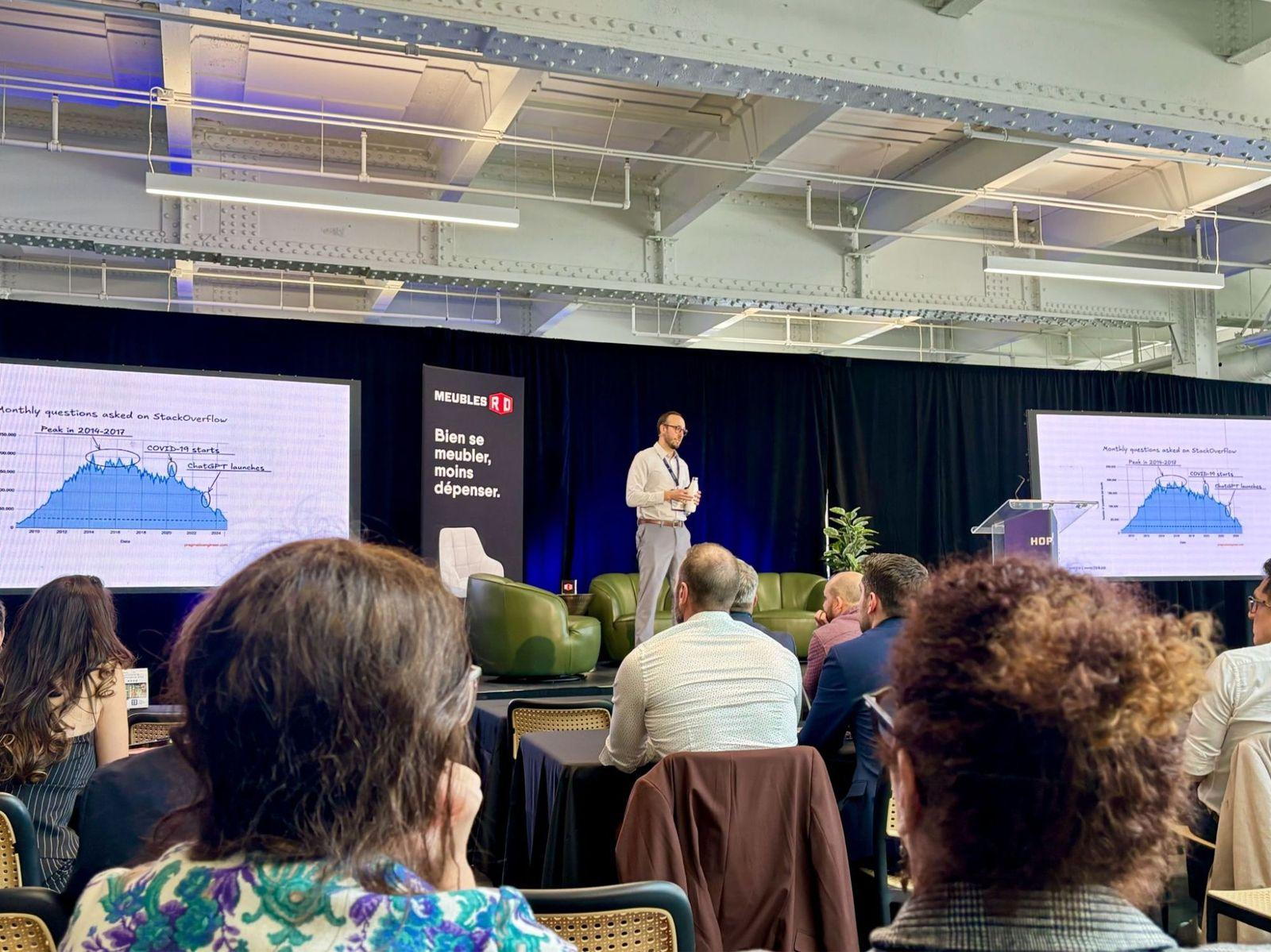
Gabriel Tassé presenting a chart of monthly questions asked on Stack Overflow

My professional training

Artificial intelligence, digital marketing, innovation, leadership or responsible digital practices: my trainings combine research, field experience and critical reflection to help participants understand what is changing, challenge common assumptions and develop their own judgment.

Understanding what is changing. And what truly deserves to change.

We are constantly exposed to new technologies, predictions about the future of work and promises of transformation.

It can become hard to tell real advances from passing trends, interesting possibilities from risky uses, and urgent decisions from those that deserve more thought.

This is especially true of artificial intelligence.

My trainings explore these questions through research, concrete examples, case studies and discussion. They aim to build a solid enough understanding of the issues for participants to form their own opinion.

Here are the main topics I cover.

  1. Generative artificial intelligence: understanding the possibilities and the limits

    Artificial intelligence · Generative AI · Digital literacy

    Generative artificial intelligence is taking up more and more space in our professional and personal lives. It promises to save us time, improve our productivity and make capabilities once reserved for specialists widely accessible.

    But how does it really work? Why can it produce impressive answers while making mistakes that are sometimes hard to spot? And what should we understand about these technologies before we trust them?

    This training offers an accessible and critical introduction to generative artificial intelligence.

    We explore the principles that allow systems like ChatGPT to produce content, their current capabilities, their limits and the main misconceptions about how they work.

    Participants also discover the consequences of these technologies for work, creation, learning and decision-making.

    Key questions covered:

    • How does generative artificial intelligence really work?
    • What can it accomplish today, and what are its limits?
    • Why can generated answers be convincing yet inaccurate?
    • How do we tell real possibilities from exaggerated promises?
    • Which human skills are becoming especially important?

    Audience: Professionals, managers, executives and teams who want to build their general knowledge of artificial intelligence.

    Discuss this training : Generative artificial intelligence: understanding the possibilities and the limits
  2. Responsible artificial intelligence: developing your judgment in the age of algorithms

    Responsible AI · Ethics · Critical thinking · Sustainability

    We already entrust an impressive number of tasks and decisions to digital technologies.

    With generative artificial intelligence, this delegation takes on a new dimension. We can now ask a machine to advise us, explain complex situations and help us make decisions.

    But how far can we trust it?

    This training explores the ethical, social and environmental issues of artificial intelligence, with particular attention to the reliability of information and the place of human judgment.

    We cover hallucinations, cognitive biases, disinformation, privacy, intellectual property and the environmental consequences of these technologies.

    Through case studies and concrete situations, participants are invited to question their reflexes, test their intuitions and develop a more critical stance.

    Key questions covered:

    • Why do we tend to trust AI’s answers?
    • How do we recognize biases, hallucinations and manipulation mechanisms?
    • What risks come with using these tools at work?
    • What are the social and environmental impacts of artificial intelligence?
    • How can we use these technologies thoughtfully and responsibly?

    Audience: Professionals, managers, public organizations, professional associations and teams who want to build a culture of responsible AI use.

    Discuss this training : Responsible artificial intelligence: developing your judgment in the age of algorithms
  3. Artificial intelligence in business: moving past the hype to make informed choices

    Strategy · Innovation · Organizational transformation

    Artificial intelligence has become an unavoidable topic in organizations’ strategic discussions.

    Executives face promises of productivity gains, competitive pressure and a growing number of technology solutions.

    In this context, it can be tempting to rush into automation opportunities or adopt new tools simply because they are available.

    This training takes a step back from those reflexes.

    We explore the conditions that allow artificial intelligence to create real value, the limits of technology-only approaches and the consequences of AI adoption for organizations.

    Particular attention is paid to the quality of decisions, governance, human skills and the transformation of work.

    Key questions covered:

    • Where can artificial intelligence really create value?
    • How do we tell relevant uses from projects driven by hype?
    • What are the risks of excessive automation?
    • How do we prepare teams for changes in their work?
    • What place should human judgment have in AI-assisted decisions?

    Audience: Executives, managers, innovation and digital transformation leads.

    Discuss this training : Artificial intelligence in business: moving past the hype to make informed choices
  4. Digital marketing: understanding consumers and rethinking strategies

    Digital marketing · Strategy · Consumer behaviour

    Digital marketing has changed considerably since my early years in the field.

    Consumers now have almost unlimited access to information. They compare, research, discover and make their decisions across a multitude of platforms and touchpoints.

    Companies, for their part, must deal with increasingly automated advertising environments, data that can be hard to interpret and less predictable purchase journeys.

    This training helps participants better understand the mechanisms that shape digital behaviour and organizations’ strategic choices.

    We explore the principles of digital marketing, customer journeys, discoverability, performance measurement and the changes brought by artificial intelligence.

    The goal is to develop an integrated understanding of digital marketing and of the decisions that create value for companies and their customers.

    Key questions covered:

    • How is consumer behaviour changing in digital environments?
    • How do the different channels contribute to discovery and purchase decisions?
    • Why can performance metrics sometimes mislead us?
    • How is artificial intelligence transforming search, advertising and customer experience?
    • How do we build digital strategies aligned with business objectives?

    Audience: Marketing professionals, entrepreneurs, managers and communications leads.

    Discuss this training : Digital marketing: understanding consumers and rethinking strategies
  5. Data and business intelligence: learning to ask the right questions

    Data · Analytics · Decision-making · Performance

    We have access to an amount of data that would have been hard to imagine a few decades ago.

    Yet organizations keep making decisions based on incomplete indicators, misread dashboards or conclusions that seem obvious but do not always hold up under closer analysis.

    This training explores the place of data in decision-making.

    We cover the principles of business intelligence, performance indicators, interpretation biases and the limits of measurement models.

    Participants are invited to read data more critically and to think about how it can support strategic decisions.

    Key questions covered:

    • How do we tell interesting data from truly useful information?
    • Which indicators help us better understand performance?
    • Why can some metrics lead to bad decisions?
    • How do we recognize the biases and limits of an analysis?
    • How do we build a data-informed decision culture without losing our judgment?

    Audience: Managers, marketing professionals, executives and teams responsible for performance.

    Discuss this training : Data and business intelligence: learning to ask the right questions
  6. Leadership and transformation: leading in an accelerating environment

    Leadership · Innovation · Change management

    Leading an organization has always meant dealing with uncertainty.

    But technological acceleration adds a particular pressure. Companies must constantly rethink the way they work, develop new skills and make decisions in fast-changing environments.

    Artificial intelligence amplifies several of these challenges.

    How do we support teams when tools change faster than habits? How do we encourage innovation without multiplying pointless initiatives? And how do we preserve managers’ ability to think when they are constantly asked to go faster?

    This training explores the challenges of leadership in a context of digital transformation.

    It draws on management research, the human side of change and my experience as an entrepreneur and executive.

    Key questions covered:

    • How do we make better decisions in an uncertain environment?
    • Why do some transformations fail despite good intentions?
    • How do we build a culture of learning and experimentation?
    • How do we support teams through technological change?
    • Which human capabilities must we preserve in increasingly automated organizations?

    Audience: Executives, managers, entrepreneurs and transformation leads.

    Discuss this training : Leadership and transformation: leading in an accelerating environment

How I teach

Getting people to think, not just passing on information.

I have been teaching for several years and I still find it fascinating to see how the same topic can trigger very different reactions depending on who is in the room.

A training on artificial intelligence does not raise the same questions with engineers, health professionals, managers or students.

Participants’ knowledge, experience and concerns greatly influence the way they approach a topic.

That is why I place great importance on discussion and on challenging common assumptions.

I like to present research that surprises, test certain beliefs against the facts, explore contradictions and let participants form their own opinion.

I also use role plays, reflection exercises or group discussions so participants can compare their intuitions with those of others.

I believe a good training should leave us with new knowledge, but also with better questions.

And sometimes, with a few fewer certainties.

Training and certifications with recognized institutions

Alongside my professional activities, I teach and work with several training institutions.

These experiences let me meet varied audiences, test concepts against different realities and keep improving my course content.

HEC Montréal and its École des dirigeants

I teach digital marketing at HEC Montréal and take part in training activities for professionals, managers and executives.

My trainer profile at the École des dirigeants is associated with two programs in particular.

  • Digital Marketing Certification — 6 days

    A program that gives participants an integrated understanding of digital marketing and has them work on building a strategy through hands-on exercises.

  • Retail Certification — 5 days

    A program on strategic retail practices and the changing ways of reaching, serving and retaining consumers.

See my profile at the École des dirigeants (in French) (opens in a new tab)

These certifications are offered by HEC Montréal’s École des dirigeants. Dates, terms and registration are managed by the institution.
Institut de leadership

I also work with the Institut de leadership on training for professionals and managers.

My sessions focus on artificial intelligence, the changes it brings and the ethical and responsible issues that come with its adoption.

In-house training

I also offer training and workshops tailored to organizations that want to explore certain strategic issues in more depth, build their digital literacy or better understand the changes affecting their industry.

Depending on the context, we can explore a specific topic or build a program combining several complementary themes.

Discuss a training for your organization

Experience that brings together teaching and entrepreneurship

I founded my first company in 2007, then took part in creating and growing several organizations, including Click & Mortar, which I co-founded in 2016.

Over the years, I have supported companies of all sizes with their digital strategies, marketing projects and technology transformations.

In 2025, Click & Mortar merged with Tink, where I am now Vice-President, Strategy, Innovation and Thought Leadership.

In parallel, I teach at HEC Montréal, its École des dirigeants and the Institut de leadership.

These two worlds feed each other.

My work in business makes me test concepts against very real constraints: budgets, available resources, growth targets and organizational change.

Teaching, for its part, forces me to step back, deepen my knowledge and find more accessible ways to explain sometimes complex subjects.

I enjoy carrying what I learn from one world to the other.

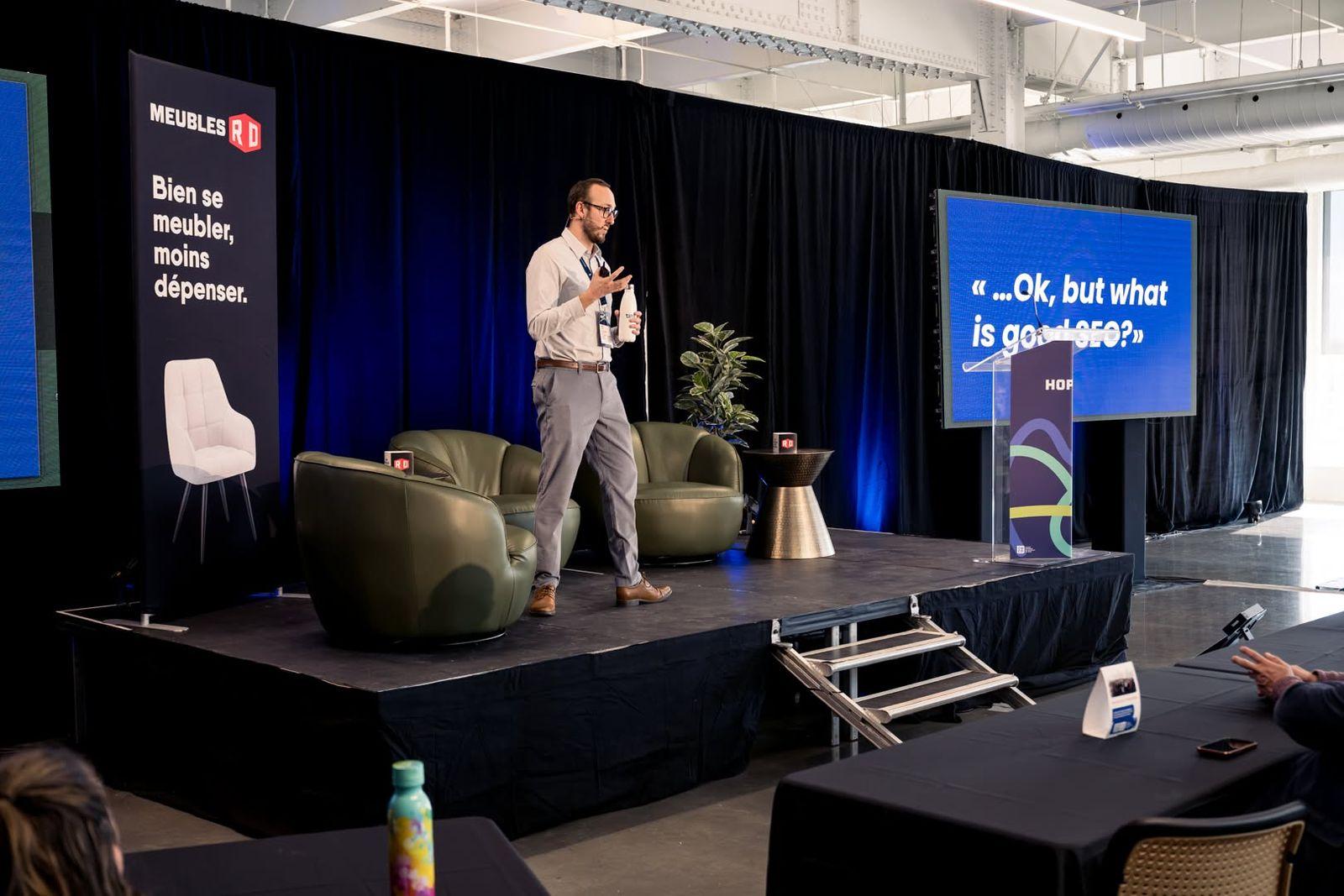
Gabriel Tassé on stage, next to a screen reading “…Ok, but what is good SEO?”

Formats suited to your goals

Every organization has its own questions and its own challenges.

Some want to build a shared understanding of a topic. Others want to explore a strategic issue in depth or spark discussion within their leadership team.

Trainings can be adapted to the audience, participants’ current knowledge and the goals you are after.

  • Awareness session

    To discover a topic, challenge some common assumptions and build a shared understanding of the issues.

  • Professional training

    To go deeper into a field, explore the important research and concepts and strengthen analytical skills.

  • Reflection workshop

    To discuss complex issues, compare different perspectives and think through the consequences of certain decisions.

  • Executive training

    To help executives and managers step back from the changes affecting their organization and reflect on their strategic choices.

  • Development program

    To explore several complementary topics and gradually build a more complete understanding of a field.

Trainings can be delivered in person or remotely, depending on the topic and the learning goals.

What participants say

I place great importance on participants’ feedback. It helps me understand what was useful, what deserves more depth and how I can improve my trainings.

  • “Very clear, well-structured information and excellent examples. The integrative exercises were very useful and the pace was just right. Thank you!”
    Filip — Participant
  • “I was apprehensive about this training, afraid I wouldn’t understand, but I was wrong. I loved the presentation, the explanations and the case studies. Well done!”
    Catherine — Participant
  • “Truly great! Congratulations to the trainer. The world of SEO, SEA and SXO was unfamiliar to me, but we got an excellent overview of how to maximize our online presence.”
    Marie‑Ève — Participant
  • “Good training! Thank you for adapting the content to our level of knowledge, it was much appreciated.”
    Marie‑Pier — Participant

Frequently asked questions about my training

Do you offer artificial intelligence training for beginners?

Yes. Several trainings are designed for people who want to understand artificial intelligence without necessarily having technical knowledge.

The goal is to build an accessible understanding of these technologies, their possibilities, their limits and their consequences.

Do participants need technical knowledge?

Not necessarily. The level of depth can be adapted to participants’ knowledge.

Some trainings cover technological concepts, but they generally focus on understanding the issues and their professional implications rather than learning tools in detail.

Do the trainings include hands-on exercises?

Depending on the topic, trainings can include case studies, role plays, reflection exercises, demonstrations and group discussions.

These activities let participants test the concepts against concrete situations.

Can we organize a training for our leadership team?

Yes. Some trainings are particularly suited to executives and managers who want to explore the strategic issues of artificial intelligence, innovation and digital transformation in more depth.

Can the content be customized?

Yes. We can adapt the topics, the examples, the level of depth and the activities to your industry and your organization’s goals.

Do you offer training in English and French?

Yes. Trainings can be delivered in English or French, as needed.

Is certified training available?

I take part in training programs offered by institutions such as HEC Montréal’s École des dirigeants.

Institutional certifications are administered by the institutions concerned. Trainings offered directly to organizations are not automatically certification programs.

How can I find out about fees and availability?

Send me a few details about your project: the topic, the audience, the number of participants, the desired length and the dates you have in mind.

We can then discuss the content and the arrangements.

What is the difference between a talk and a training?

A talk is generally a way to discover a topic, explore new perspectives and spark reflection.

A training offers more time to go deeper into the concepts, discuss the issues and build a more structured understanding.

Discover my talks

Want to get your team thinking?

Would you like to build a better understanding of artificial intelligence? Step back from the changes in your industry? Or give your managers the chance to think through the decisions ahead of them?

Tell me what you have in mind.

We can talk about your goals, your team’s concerns and the format that would best suit your organization.